

BITRI Emphasises Commitment to R&D That Provides Solutions
- September 17, 2026
- Posted by: root
- Category: News
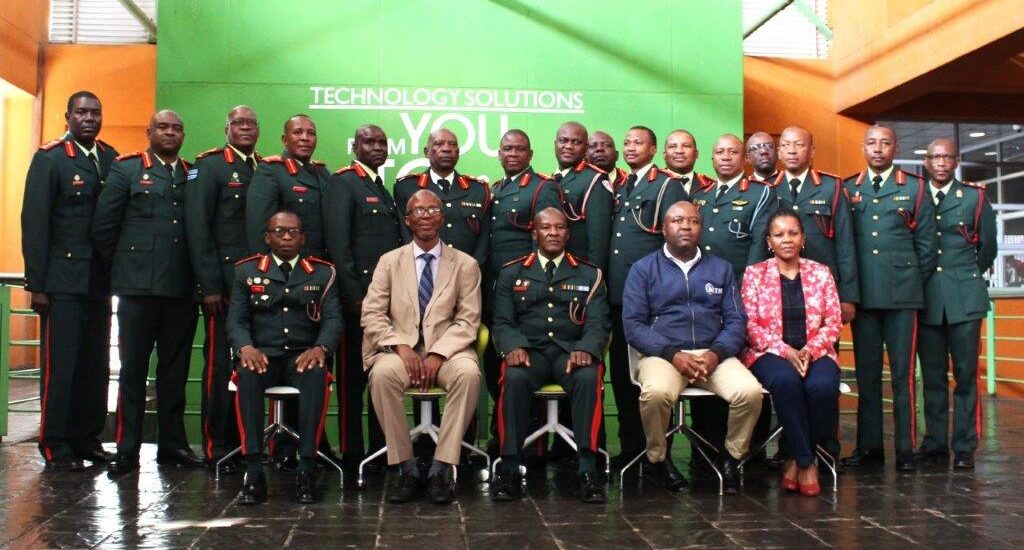
The Botswana Institute for Technology Research and Innovation (BITRI) is transitioning to the 2026 – 2031 Corporate Strategy focused on research and development (R&D) that is premised on execution discipline, positive impact on society, and financial sustainability. BITRI) is entering a new strategic cycle under its 2026 – 2031 Corporate Strategy, placing disciplined research and development (R&D), measurable societal impact and financial sustainability at the centre of its mandate. The new strategy positions BITRI to translate scientific research, technology and innovation into practical, market-oriented solutions that respond to Botswana’s evolving national priorities, including economic development, national security, digital transformation, healthcare, infrastructure, and human capital development.
This was shared by the BITRI Chief Executive Officer Dr Sebusang Sebusang during the Botswana Defence Force (BDF) visit to BITRI under the Capstone Senior Leadership Program. The visit held under the theme, “Botswana’s Research Environment and Military Partnerships”,wasintended to explore further R&D opportunities between the BDF and BITRI as the latter has been identified as one of the key stakeholders in delivering national security and prosperity. Dr Sebusang emphasised that the new strategy places greater emphasis on strengthening partnerships across government, State-Owned Enterprises (SOEs), academia and the private sector to mobilise resources, accelerate the commercialisation of home-grown innovations and ensure that public investment in R&D delivers tangible and sustainable value to society. The CEO said the Institute was in line with the Botswana’s National Development Plan 12 (NDP 12) core pillars of Economic Growth and Development, Infrastructure, Public Administration, Human Capital Development, Social Development, and Regional Development as well as the three key social areas of Healthcare, Education, and Social Protection under Botswana Economic Transformation Programme (BETP), adding that the theme of the BDF tour was apposite since both institutions had a long-standing relationship aimed at pioneering research and innovation that would strengthen the country’s defence readiness and ensure sustainable operational capabilities.
“The core of the BITRI’s work remains responding to the country’s needs with practical solutions, and that collaboration is critical given limited resources. There are never enough resources. Where we can work together to pool resources, the better. That would allow us to circulate money longer in the local economy,” Dr Sebusang said.
Dr Sebusang revealed that the Government of Botswana had cumulatively invested over P1 billion in BITRI over the past 12 years in development and recurrent budget components, warning that under the new austerity measures, the Institute was targeting contract research, partnership funding, and institutional collaborations as the key revenue streams to funds its projects and operations. The CEO said this shift will help to deliver market-ready solutions that support substantive and meaningful job creation, security, and realisation of the digital government ideal. Dr Sebusang highlighted BITRI has capabilities such as Wireless Sensor Networks (WSN) that the BDF could use for tactical navigation of troops, including during antipoaching patrols and operations. Other capabilities highlighted included developing an asset master register list that can track all the critical facets of assets life, including date of purchase, scheduled service, maintenance intervals, as well as scheduled disposal.
Dr Sebusang said BITRI’s capabilities extended across a broad range of areas aligned to the BTEP, highlighting amongst such a project development of a permit system that helped regulate and control the movement of people during the COVID-19 pandemic. The CEO added the Institute’s had collaborated with the Ministry of Health portfolio to develop the Botswana Health Master Facility List (MFL), which is an online directory of public and private healthcare facilities in the country, as well as Botswana Electronic Medical Records System (EMR), a web-based centralised system intended to amongst others, improve patient care through centralised access to patient records, up-to-date and accurate information and reporting through integrations to other systems and the MFL.
The CEO highlighted other initiatives including the wound-healing research project that is still at an early stage, and the capacity-building training in genomics and bioinformatics for government and strategic partners. Turning to agriculture and biosecurity, the CEO said BITRI is concentrating on diseases with significant economic implications for Botswana, including Foot and Mouth Disease (FMD) and Lumpy Skin Disease and was currently undertaking R&D that is focused on developing rapid testing capabilities that can enable earlier detection and faster interventions, alongside the development of biosensors.
Dr Sebusang further added that BITRI is also positioning itself to support Botswana’s mineral beneficiation and clean-energy ambitions, among the areas under investigation being the beneficiation of Botswana’s abundant coal resources and research aimed at supporting cleaner energy solutions. In base-metal beneficiation, the CEO said research is targeting nickel, copper, cobalt and platinum group metals (PGMs), while battery research is exploring alternatives suited to Botswana’s resource endowment.
“Botswana does not have lithium, but we have abundant sodium,” Dr Sebusang said, explaining that BITRI is therefore exploring sodium-based alternatives as part of its research innovating battery technologies. On renewable energy, he highlighted the institute’s progress towards energy self-sufficiency, highlighting that BITRI currently meets 100 per cent of its energy requirements during working hours through its solar roof top renewable-energy installation. He further stated that BITRI is engaging other state institutions to explore how similar renewable-energy solutions could be adopted across government, further highlighting that the breadth of BITRI’s R&D demonstrated the Institute’s role not only as an institution, but as a platform for translating science, technology, and engineering into practical solutions for Botswana’s health, biosecurity, food security, energy, industrialisation, and employment creation priorities.
Dr Sebusang emphasised that BITRI intended to position itself as a driver of government digitalisation, calling for robust telecoms infrastructure such as fibre and WSN, as well as systems that could gather data in real time.
“Digital platforms are easy to audit, thereby contextualise decision-making and solely relying on best practices or intelligent guesses. Robust data aggregation is needed before the country can fully benefit from technologies such as AI,” Dr Sebusang emphasised.
Contributions from the BDF delegation emphasised themes such as the need for collaborations to develop cutting edge military innovations, safety and security, a well a model and structure that would drive towards long-term financial and strategic sustainability.
The delegation was further taken through a familiarisation tour of the BITRI Centre for Materials Science and the Additive Manufacturing where they were taken through various value-adding proposition BITRI could contribute towards the BDF’s operations and sustainability.
When giving a Vote of Thanks, Col Keabonye Mokoma, speaking on behalf of the BDF Commander and Capstone participants, congratulated BITRI on progress it has made in fulfilling its R&D mandate since its inception, adding that the Memorandum of Understanding (MoU) between the twin institutions is key in driving toward home-grown solutions “in pursuit of objectives that benefit society.”
The recent visit reflects the practical value of sustained institutional collaboration between the BDF and BITRI, particularly in translating Botswana’s research and innovation capacity into solutions that address national priorities. Additionally, it provides a strong platform for the two institutions to deepen collaboration in areas where science, technology and innovation can enhance national security, operational effectiveness and long-term sustainability.
A very insightful and inspiring article that showcases BITRI’s commitment to research, innovation and developing practical solutions for Botswana. The article presents BITRI’s vision and impact across various sectors in a clear and engaging way.
Credit also goes to the website development team for creating such a clean, professional and user-friendly platform that effectively showcases BITRI’s work, achievements and contribution to national development. Excellent work by everyone involved in bringing BITRI’s digital presence to life!